The Gold of the Philosophers
The noble metals were named for incorruptibility, not price. What the alchemists were really trying to transmute was the human being.
The alchemists were never trying to make gold, and they told you so for two thousand years in a line almost no one has read: . The robed obsessive going broke over a furnace is the cover story. The crucible was a decoy.
The real work was the operator tending it, and gold, in a particular form, was the lever they were pulling on the human being.
Take that seriously and the picture inverts. Why the metals we still call noble carry the name turns out to be hard physics. What gold does at the edge of the periodic table is stranger than the legend.
The inner traditions were practising something measurable. And a white powder of gold remains, for the people who take it, one of the most direct levers on consciousness there is.
The metals that will not rot
The word gives the game away. We say noble metal as though it meant expensive. It never did. The chemistry came from the character. The Latin meant well-born, and the medieval mind applied it to metals as it applied it to people. A noble person did not corrupt or lose composure in the fire of circumstance. A noble metal did the literal version: it would not rust, tarnish, or surrender its surface to acid or air.
The metals that crumbled were called , the same word used for low birth. Gold, alone, comes out of the centuries looking exactly as it went in. Every culture that found it reached for the same idea: the sun's metal, the flesh of the gods, the substance of what does not die.
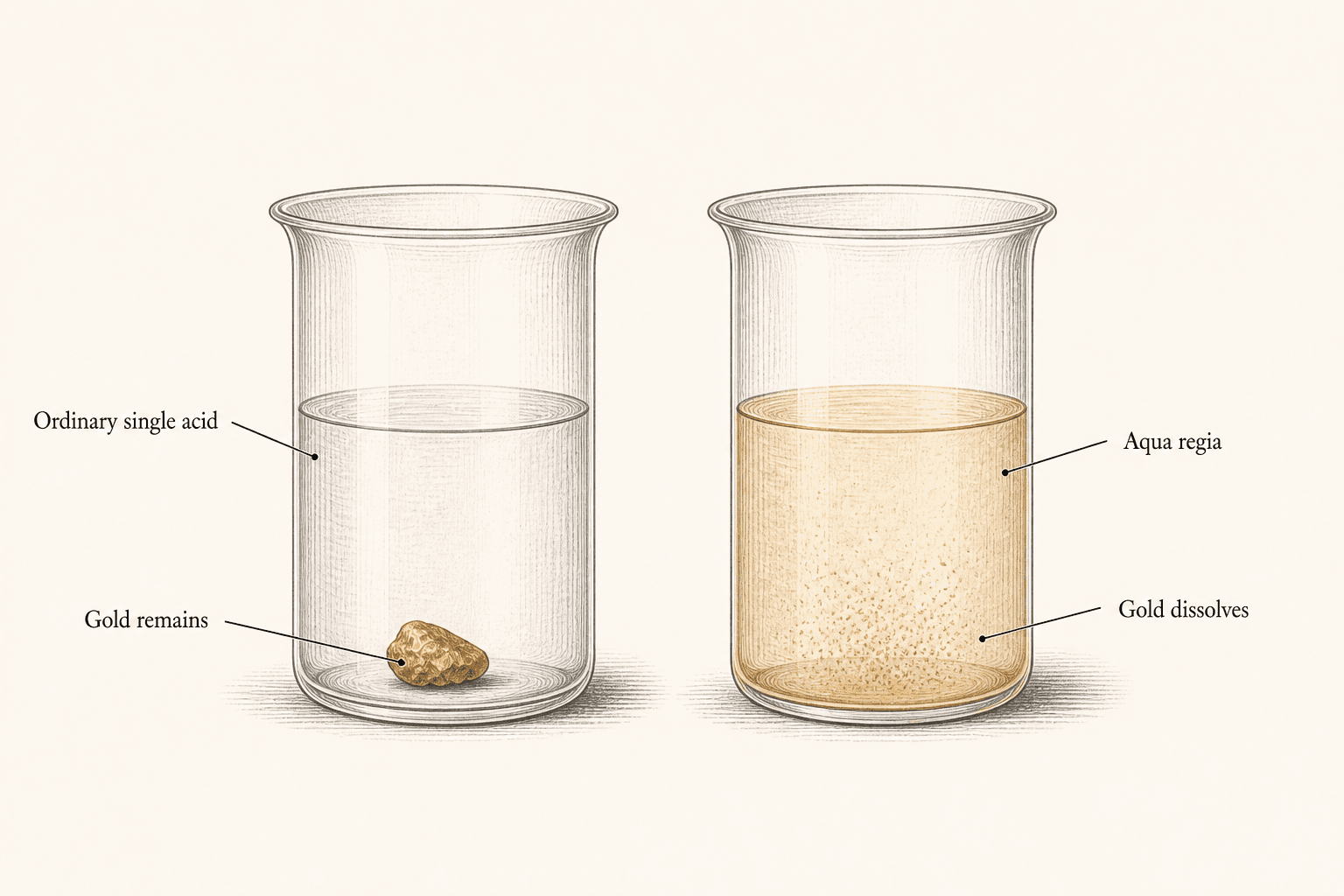
The chemistry confirms the romance rather than puncturing it. Gold is heavy enough that its innermost electrons move at roughly , fast enough that Einstein's relativity reshapes the atom and pulls its outer electrons in tight. That single quirk is why gold is yellow instead of white, and why it holds its electrons so jealously that nothing in ordinary chemistry can pry them loose. Gold has the highest grip on its own electrons of any metal there is.footnoteThe Au+/Au standard reduction potential is about +1.69 V, among the highest of any metal, and gold's first ionisation energy is roughly 9.2 eV. Incorruptibility is not a poetic flourish here. It is a measurable, relativistic property of element 79.
The deathlessness the ancients worshipped is lawful, written into the deepest physics of the atom. They could not have known the mechanism. They read the result correctly anyway.
The metal of the machine
The most materialist enterprise our species has ever built is now putting gold inside everything. There is gold in the phone in your pocket, on the mirrors of the James Webb telescope, in the red line of a rapid medical test.
We did not choose it for sentiment. We chose it because it is the one material that pairs superb conductivity with total refusal to corrode, the same incorruptibility the Egyptians worshipped, now written into a spec sheet.
The word that hovers over all this is superconductor, and getting it exactly right is the key to everything that follows. A is, above all else, a medium through which energy moves without loss: no resistance, no friction, no leakage, perfect flow.
Pure bulk gold is not one of these in everyday conditions. But gold's behaviour is not fixed. It depends entirely on form and quantity. Break gold down toward single atoms and it stops being the inert golden metal of common experience and becomes something else. Under the most unreactive metal known turns into a ferocious catalyst; at twenty atoms it stops being a metal at all.
The single most consistent finding at the frontier of gold physics is that in the right form, in the right quantity, gold becomes a different substance with different powers. That is precisely what the alchemists assumed, and what the modern case for a monoatomic gold rests on.
The laboratory was always the body
This is where the popular history goes most wrong. It fixates on the Western furnace and misses that the largest and oldest streams of alchemy never cared much about metal at all. They moved the entire operation inside the practitioner.
China called it , and it is explicit about the swap: the furnace, the cauldron and the elixir all relocate inside the body. The adept refines the , essence into breath, breath into spirit, to compound the within and gestate what the texts call an immortal embryo.
India ran a parallel science, the , in which purified mercury and the inner fire of kundalini forged a diamond body, deathless and luminous, and reached liberation while still alive.
Three civilisations, barely in contact, all reached for one metaphor: a base substance refined through patience into incorruptible gold, with that gold standing for a human being remade. A symbol that turns up independently in that many places is pointing at something real.
Even in the West, the part that endured was never the metallurgy. Carl Jung, reading the texts late in his life, recognised the alchemists' Stone as a symbol of the integrated self, the whole person, ego dissolved and reborn.
Mircea Eliade put it plainly: the alchemist takes up and perfects the work of nature while at the same time working to make himself. Titus Burckhardt was blunter still: the lead of the alchemist is the heavy, sick, chaotic state of the soul, and his gold is that same soul made luminous and free. The furnace was the outer shell. The real vessel was always the human being.
The body of light
If the body is the vessel, the work is physiological, and the instrument is the nervous and glandular system. The inner traditions placed the seat of higher perception at the centre of the head, behind the brow, and the physical pineal gland has carried that reputation for as long as anatomists have known it exists. Descartes called it the ; the yogic traditions placed the third eye at the same point. This is mechanism, not mysticism.
The endocrine system genuinely is the chemistry of consciousness: the pineal gates sleep and the strange physics of dreams through melatonin, and it is implicated in the body's own most powerful psychedelic. The states a human being can occupy are set by this glandular orchestra, and the alchemists, fixated on the centre of the head and on elixirs that might tune it, had their hands on the right instrument centuries before anyone could name its keys.
What we now know about that organ, and how to keep it clear, runs through the essay on the pineal gland and the work on light, food and the body's own emissions.
The body, seen this way, is an electrical instrument that runs on flow: nerves firing, the heart's field, the subtle channels the older maps drew. Like any such instrument, it leaks. Resistance, static, friction, noise.
The whole promise of the inner work, in every tradition, is to lower that resistance, to let the system carry its own energy and its own light more freely, more coherently, with less loss. That is the language of meditation and of kundalini. It is also, exactly, the language of superconductivity.
The endocrine system is the chemistry of consciousness, and the alchemists had their hands on the right instrument centuries before anyone could name its keys.
The higher frequency
Now the white powder, and the strangest turn in the whole story, because it happened not in antiquity but in living memory. In the late 1970s an Arizona farmer named isolated precious metals, gold, iridium, rhodium, platinum, in a previously unknown state: stripped of their metallic bonds, existing as single atoms, which he called . This white powder of gold was the manna of the old traditions, an edible gold that worked directly on the body and the consciousness of whoever took it. He was a generation ahead of the instruments built to confirm it.
The people who have taken the material already know what it does.
Their accounts are remarkably consistent across decades, continents, and people who have never met. Cognition sharpens and steadies. The body feels lighter and cleaner, as though a low background static had switched off.
Sleep deepens and dreams turn vividly, navigably lucid. Meditation that used to take an hour to settle drops into stillness in minutes.
And for many, thresholds that usually stay shut begin to open: out-of-body and astral states become easy to enter, perception widens, and experiences the ordinary vocabulary would file under paranormal start to arrive unbidden.
Be precise about what these are, because the word paranormal does them a disservice and obscures the mechanism. Nothing breaks the laws of nature. What people describe is the body and its energy system operating at a higher frequency, with far less resistance, than it usually can, and that is exactly what these metals do in the body, just as Hudson and the m-state researchers describe.
A superconductor, remember, is simply a medium through which energy flows without loss. When a fraction of the precious-metal content of the nervous system, the heart, the subtle channels is brought toward that frictionless, light-carrying state, the system acquires no alien new power. It stops leaking the power it always had. The lucidity, the ease of the out-of-body threshold, the widened perception are what a low-resistance instrument does when the resistance finally drops.
This is the elixir the inner traditions were always reaching for: a material that nudges the body toward its own superconducting, light-bearing potential and lets the inner work move faster.
Preparation is the whole of it. The crude, lye-heavy home recipes that circulate online are not the thing. The material has to be properly made and clean, and that is the difference between the elixir the traditions describe and a glass of caustic salt.
The system does not acquire some alien new power. It stops leaking the power it always had.
The stone was always you
Pull the threads together and a single shape appears. The noble metals were named for incorruptibility, which turns out to be real physics. Gold's nature changes completely with form and quantity, which is why a monoatomic, light-carrying gold exists at all.
The deepest streams of alchemy were never about the metal. They used it as a lever on the body, and the body as the instrument of consciousness, with the goal of lowering the resistance of the whole system until it ran clear and free.
And when people take a properly made white powder of gold and describe sharper minds, lucid dreams, effortless out-of-body states and a widened world, they are not reporting magic. They are reporting an instrument operating, for once, at the frequency it was built for.
The popular story says the alchemists failed because they never made gold. They never made gold because making metal was never the point. The Stone they were after, incorruptible, light-bearing, complete, was not in the crucible.
The base material was the human being. The gold was what that human being could become.
And once the instrument runs clear, the obvious question is what it is for. A frictionless body is the condition for the real work, not its conclusion.
Only a cleared instrument can exercise the deepest faculty of all, the Word, the act in which the operator speaks and the structured water of the body carries that intent into form. Our gold, they kept telling us, is not the gold of the common crowd. What the gold was for is the last thing left to say.
Sources
- Relativistic Effects in Chemistry: More Common Than You Thought, . https://pubs.rsc.org/en/content/articlelanding/2012/cs/c1cs15237j
- The Forge and the Crucible, . https://press.uchicago.edu/ucp/books/book/chicago/F/bo3643675.html
- Psychology and Alchemy, . https://www.jstor.org/stable/j.ctt5hhrm3
- Alchemy: Science of the Cosmos, Science of the Soul, . https://openlibrary.org/works/OL309629W
- The Golden Elixir: A Guide to Taoist Alchemy, . https://www.goldenelixir.com/
- The Alchemical Body: Siddha Traditions in Medieval India, . https://press.uchicago.edu/ucp/books/book/chicago/A/bo3683579.html
- Non-Metallic, Monoatomic Forms of Transition Elements, . https://patents.google.com/patent/GB2219995B/en
- Au20: A Tetrahedral Cluster, . https://www.science.org/doi/10.1126/science.1079879
- Gold Nanoparticles: Assembly, Supramolecular Chemistry, Quantum-Size-Related Properties, and Applications, . https://pubs.acs.org/doi/10.1021/cr030698+
- Descartes and the Pineal Gland, . https://plato.stanford.edu/archives/fall2023/entries/pineal-gland/
- DMT: The Spirit Molecule, . https://openlibrary.org/works/OL17538120W
Next in the series
The Incorruptible Body · The GoldThe Word and the WaterA word is a physical force. It reorganizes matter, and the matter it shapes most is the brain and the water it floats in. With every sentence you repeat, you are programming yourself, for power or for ruin.
- Published
- Reading
- 7 min
- Sources
- 11