
Sexual Transmutation
The most concentrated creative material the body makes, the spinal channel it can rise through, and the discipline that turns appetite into output.
Nikola Tesla patented the alternating-current motor at thirty-two, slept three hours a night for sixty years, and never once in his life spent the one faculty most people discharge without ever asking what it was for. Asked about it late in his career, he answered plainly: he could not name many great inventions made by married men. He was not making a joke. He was reporting the design.
The list closes around the same point from every direction. Newton, lifelong celibate. Leonardo da Vinci, lifelong celibate. Beethoven, mostly so. The Buddha after his enlightenment. Kant, Pascal, Kierkegaard, Nietzsche.
And the pattern was never a male one. Hildegard of Bingen ran a monastery and a polymath body of music, medicine, and visionary theology from inside a lifelong vow of celibacy. Florence Nightingale refused her suitors and named the marriage she turned down a kind of suicide of her vocation. Teresa of Avila reformed an order and wrote its deepest mystical texts from the same discipline.
The men and women who reshaped the categories of human knowledge had, almost without exception, a disciplined relationship with the deepest drive in the body. The pattern is not coincidence and it is not repression. It is conservation, applied to the most concentrated creative material the body carries.
And the material itself is not one sex's possession. In a man it is the seed. In a woman it is the ovum, the largest single cell the human body builds, about a tenth of a millimetre across and right at the edge of what the naked eye can see, tens of thousands of times the bulk of the sperm that meets it.footnoteThe human ovum is the largest cell in the body, roughly 0.1 mm in diameter and near the limit of naked-eye visibility, while the sperm is among the smallest; by volume the egg exceeds a single sperm by tens of thousands of times. Moore, K. L., Persaud, T. V. N., Torchia, M. G., The Developing Human, Clinically Oriented Embryology (11th ed.), ch. 2.
She is born holding every egg she will ever carry and releases only a few hundred across a lifetime, where a man manufactures the seed without pause.footnoteA human female is born with her entire oocyte reserve, roughly one to two million at birth, declining to a few hundred thousand by puberty, of which only some four to five hundred are ever ovulated. Baker, T. G., A quantitative and cytological study of germ cells in human ovaries, Proc. R. Soc. Lond. B 158 (1963), 417-433.
Two anatomies, one principle: the most concentrated creative material the body makes, and the single question of whether it is spent at the lowest gate or kept and raised.
Spend the seed downward and you get the life most people get. Direct it upward and you get something else entirely.
What rises when the sexual force is kept and channelled instead of dissipated has a name at least three thousand years old, a measured path through the body, and a hormonal answer that arrives on the order of a week. The modern environment makes the discipline harder than at any prior moment in human history. Every part of that is mechanism, and every part of it is a lever.
What the yogic tradition has always known
The seat of the sexual force is the base of the spine. The yogic tradition calls the latent energy coiled there , the serpent power. Spent through the lower channels, it follows the path every animal body follows: outward, toward reproduction, toward the next anticipated reward, toward the dissipation nature uses to keep the species going. Conserved, in a body disciplined enough to hold it, the same force begins to rise.
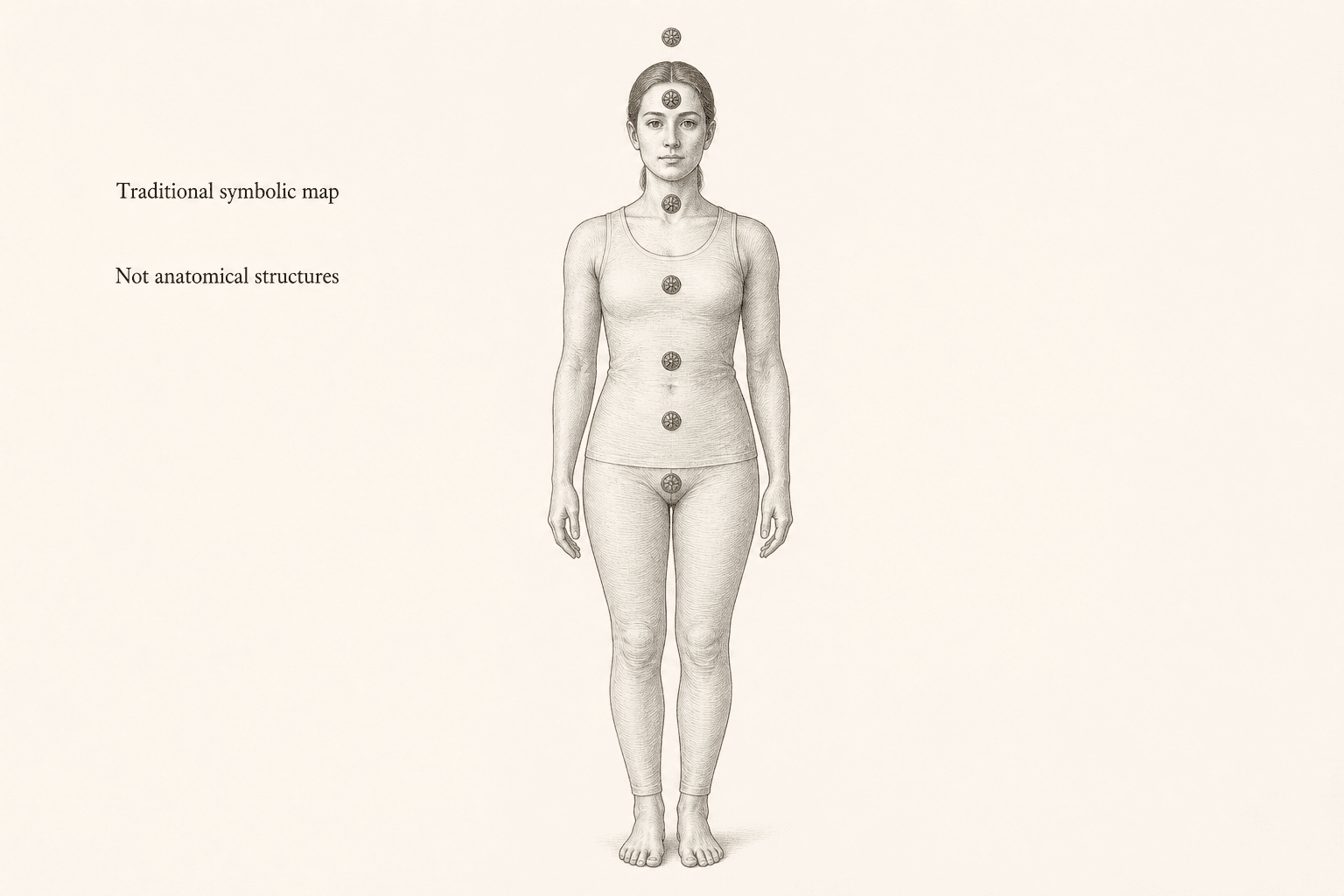
The path it takes is the , the central channel of the spine. Rising, it passes through seven gates of consciousness, each one a centre in the body and a set of faculties of the mind. These are the seven . The map is consistent across yogic, tantric, Daoist, and many of the older Hermetic traditions, and the inner experience practitioners report walking the path matches the map. The cartography is standard.
Walk them from the floor up. Each gate is a region of the body, a gland, and a way of being in the world, and you can usually tell from across a room which one a person is living at.
Muladhara, the root
Base of the spine, at the perineum. Red. Earth. The associated gland is the adrenals. The kundalini lies here in its latent form, and in most people it never once stirs from it. The faculties are survival, security, grounding. Closed, with the energy pinned at the base, the dominant emotion is fear. Open, you walk through the world without flinching from it.
Svadhisthana, the sacral
Below the navel. Orange. Water. The gonadal endocrine line. This is the gate the energy must rise through, and the gate at which most modern people lose it. The faculties are sexuality, pleasure, creativity. The pornographic industry and the algorithmic feed are engineered to keep the energy pinned at this gate, spent and respent and never rising. Conquer it, pass the energy through instead of leaking it out, and the creative force the gate governs becomes available to the higher faculties. This is the actual mechanism of what older writers called creative sublimation.
Manipura, the solar plexus
Above the navel, at the diaphragm. Yellow. Fire. The pancreas and the digestive viscera. The faculties are will, agency, personal power. Open this gate and you stop apologising for taking up space. The fire of the third chakra is what holds the discipline across years.
Anahata, the heart
The centre of the chest. Green. Air. The thymus. The faculties are love, compassion, connection. This is the first gate beyond the lower three, and the first at which the energy starts to feel qualitatively different. Below the heart, the work is mostly about appetite. At the heart, it starts to be about presence.
Vishuddha, the throat
The throat. Blue. Ether. The thyroid. The faculties are truth, voice, expression. What you say carries weight at this gate. People can hear you. The lies a person tells themselves while the lower gates are running thicken in the throat and close it; the discipline thins them.
Ajna, the third eye
Between the eyebrows, deep in the centre of the skull. Indigo. The seat of the pineal gland. The faculties are intuition, insight, vision. The traditional name is the third eye because the eye that opens here sees through, into the architecture of things rather than only their surface. The yogis who have walked the path describe a literal opening of perception at the sixth gate.
Sahasrara, the crown
The top of the head. Violet, or pure white, or no colour. The pituitary. The faculty is consciousness itself, undivided. When the energy reaches this gate the practitioner enters samadhi, and the relationship between the personal self and what is larger than it changes. This is the goal of the discipline at the limit.
Why most modern people cannot feel any of this
Walk into any major city and look at the population. The energy is pinned at the second gate, almost universally. The eye is hooded. The posture collapses forward at the sternum. The face has the flatness of someone who has been spending a faculty for so long they no longer remember it was one. The upper four chakras might as well not exist. The third eye is dark.
Two reasons, and they compound.
The first is the saturation of the visual environment. The eye of a person in 2026 is hosed continuously with engineered sexual imagery at intensities the ancestral nervous system has no defence against. The drive is fired all day, every day, by stimuli more potent than any encounter in the natural world. The energy is spent before it can rise. Pinned at the second gate, the upper five never get visited at all.
The second is the calcification of the pineal gland itself. The small organ at the centre of the brain that corresponds to the sixth chakra hardens with age in nearly every adult in the industrial world. Fluoride in the water, bromides in the food, chronic stress, chronic sleep debt, the screen exposure that suppresses melatonin output. By the fourth decade the third eye is mineralised shut.
The protocol that reverses this is set out in full in the essay on decalcifying the pineal, and it is a prerequisite for everything that follows here. The energy cannot reach a gate sealed by calcium.
The disastrous effects of dissipation
The modern medical voice calls sexual dissipation harmless. It is wrong. The cost is real and large. It is just spread across enough domains that no single specialty registers the full picture.
What an unmindful release pulls out of you, every time:
- Force at the morning hour. The clean clarity of the first ninety minutes of the day, the window the great work has always been done in, is the first thing the prolactin crash takes. A person who releases at night does not wake into the same mind. They wake into a duller, slower, more depressed version of it, and the difference compounds across a year. The prolactin surge that follows orgasm is not a male event, it has been measured climbing just as steeply in women, which is why every cost named in this section is written for both bodies.footnoteExton, M. S. et al., Cardiovascular and endocrine alterations after masturbation-induced orgasm in women, Psychoneuroendocrinology 24(3) (1999), 319-337. Prolactin rose sharply after orgasm in women, the same post-orgasm surge measured in men. https://pubmed.ncbi.nlm.nih.gov/10367606/
- Steadiness of attention. The capacity to hold one difficult question in mind for a long time. To not flinch from it. To keep returning to it across hours. This faculty, the foundation of every kind of serious work, leaks out through the second gate.
- The dreaming life. The vivid, narratively coherent, occasionally lucid dreams a clean nervous system produces in the third quarter of the night. The dream life of a heavy spender is grey, fragmentary, forgettable, anxious. The dream life of a disciplined practitioner is technicolour. People notice.
- Presence and bearing. The thing other people pick up within a beat of you walking into a room. The person who spends carries the residue of every release in the texture of the face, the eye, the voice. The person who holds the energy carries that too.
- The third eye. The most damaging long-run cost. The eye that opens at the sixth gate cannot open at all in a body firehosing the second gate every day. The intuition that is the birthright of a fully functioning nervous system is silenced. Most people never learn what they had.
Look around. The slumped posture, the wandering eye, the inability to hold a difficult thought for more than a minute, the chronic low-grade depression of the modern adult population. That is the visible signature of a faculty spent at its lowest gate, every day, for decades.
What rises when you hold it
Now the other direction, in order, as it lands.
Within a week, the morning hour starts to come back. The first thirty days are a withdrawal from the dopaminergic loop the old habits ran in, uncomfortable in roughly the same shape any withdrawal is uncomfortable. Past the first month, the texture of attention begins to change: the thing you sit down to do absorbs the drive rather than competing with it. Past three months, the dreams sharpen. Past six, the energy registers as something physical, a warmth or a current that moves in the lower belly and, gradually, upward.
Past a year of clean discipline, with the body decalcified and the protocol holding, the upper gates become accessible in a way they were not before. The intuition gets louder. Presence accumulates. Other people read you differently. The work output, compounded across the year, is unrecognisable to who you were when you started.
A 2003 study at Zhejiang University measured a clean testosterone spike in men at day seven of abstinence.footnoteSource integrity note: The Jiang et al. paper originally cited for the day-seven claim was retracted in 2021 and is not reliable evidence. The closest non-retracted human study examined endocrine differences after three weeks of abstinence: Exton, M. S. et al. (2001), "Endocrine response to masturbation-induced orgasm in healthy men following a 3-week sexual abstinence." https://pubmed.ncbi.nlm.nih.gov/11760788/ The hormonal system answers on the order of a week, and that measured spike is only the visible edge of a much larger thing.
The female endocrine system keeps a different clock, cyclical across the month rather than rebounding on a seven-day count, its own testosterone and libido cresting near ovulation, but it answers to conservation by the same logic. The deeper faculties take longer in either body, and they answer to the same input pattern.
The drive that built every living thing is not yours to abolish. It is yours to direct.
The discipline
is the yogic term for the central practice, the cleanest one-word summary of the whole discipline. The literal translation is walking in the divine; in lived practice it is the conservation and upward direction of the sexual force. Brahmacharya is not abstinence as punishment. It is the deliberate choice to keep a faculty for a higher use.
The tradition never gendered the practice. It produced brahmacharinis alongside brahmacharis, and the force the whole discipline raises, the kundalini coiled at the base of every body, is herself named shakti, the feminine principle. Nothing in what follows belongs to one sex.
is the next pillar. The body must be a vessel strong and clean enough to hold the rising energy. The classical asanas, particularly the inverted postures (shoulderstand, headstand) and the seated postures (siddhasana, padmasana), train exactly the channels the energy needs to rise through. Heavy compound lifts do the same work at the gross-muscular layer.
is the breath, the lever by which the energy is moved consciously. Even ten minutes a day of alternate-nostril breathing or bhastrika begins to clear the side channels () and make space for the central channel to carry more current.
Meditation is the attention, the single most important variable in the discipline. A mind trained to rest in stillness catches the impulse to dissipate at the moment it arises, before it cascades into the body. Without this, the other practices do not stick.
A diet steadies the substrate. Bland, moderate, regular meals. Pungent, oily, salty, stimulant-heavy foods amplify the drive at the second gate; refined sugars and ultra-processed foods drive the inflammation that lowers the threshold for impulsivity. Eat early; do not load the gut before bed. If that practice draws you toward vegetarianism, run it with the supplementation discipline set out in the essay on soil death and animal foods, or the substrate fails underneath the practice.
The gaze is its own pillar. Train the eye. When it falls on something that engages the second gate, do not let it rest.
The second glance is what starts the loop; the first is biology. Cut at the second.
The company you keep matters too. Be around people walking in the same direction. The drive is hard to hold alone in a culture that spends it everywhere.
And the work is the receiver. The drive needs a target, and the target has to be demanding enough to take the energy. Pick a question or a body of work large enough to deserve the years.
The tradition also counts what the substrate costs to make. The classical runs food to chyle to blood to tissue to fat to marrow to essence, each stage carrying forward about half of what it received. Sixty-four parts of food make one part of the last. That is the substrate the discipline conserves and the work consumes.
The arc
You will not turn this on in a day. The substrate is years in the making, on both sides of the threshold. The person who has spent the energy for decades cannot reverse the cost in a month. The one who runs the discipline cleanly for a decade carries something the population around them does not recognise but can feel.
The classical benchmark is twelve years of unbroken brahmacharya, after which the yogic texts say the practitioner attains realisation without further work. Twelve years is a long time. It is also the order of arc over which the great work tends to compound.
Tesla carried the alternating-current motor from its first vision in a Budapest park to the patents that lit the modern world over years of singular, undivided focus; Newton built toward the Principia across two decades at Cambridge. The biographies and the older texts point at the same thing: the deep results answer only to sustained, undissipated effort held across a long horizon.
Most people will not run this. The modern environment is engineered to make sure of it. Those who do will live in a different body and a different mind than the one the firehose intended for them. The energy that built every living thing is the energy that, kept and directed upward, builds the human beings who are remembered. The yogic texts name the refined essence it leaves behind .
The essence is in the brain. The path is up the spine. But conserving the force is only half of it. A current can be held and still leak, still drift back down to the gate it has always run out of, the moment attention slips.
The traditions that mapped the rising channel mapped something else alongside it: a set of physical seals, a deliberate lock at the base that turns the energy back on itself and drives it up the column under pressure. That seal is the subject of The Great Lock, and it is the difference between merely holding the charge and aiming it.
Sources
- Tesla: Man Out of Time, . https://www.simonandschuster.net/books/Tesla/Margaret-Cheney/9780743215367
- My Inventions, . https://en.wikisource.org/wiki/My_Inventions
- Autobiography of a Yogi (1946 First Edition), . https://www.ananda.org/support/files/2017/11/AYEbookDownload.pdf
- Practice of Brahmacharya, . https://www.dlshq.org/download2/brahmacharya.pdf
- The Serpent Power, . https://openlibrary.org/works/OL8421143W
- Light on Yoga, . https://www.penguinrandomhouse.com/books/85770/light-on-yoga-by-b-k-s-iyengar/
- Endocrine Response to Masturbation-Induced Orgasm in Healthy Men Following a 3-Week Sexual Abstinence, . https://pubmed.ncbi.nlm.nih.gov/11760788/
- The Developing Human: Clinically Oriented Embryology, . https://openlibrary.org/works/OL20706927W
- A Quantitative and Cytological Study of Germ Cells in Human Ovaries, . https://doi.org/10.1098/rspb.1963.0055
- Cardiovascular and Endocrine Alterations after Masturbation-Induced Orgasm in Women, . https://pubmed.ncbi.nlm.nih.gov/10367606/
Next in the series
The Incorruptible Body · The FireThe Great LockThere is one drive willpower cannot beat, so the body shipped a hardware lock for it. The three bandhas, the great lock, why injaculation is a trap, and why the conserved current needs a great work to hold it.
- Published
- Reading
- 12 min
- Sources
- 10