
Soil Death and the Case for Animal Foods, Why Most Plant-Based Diets Fail in a Depleted Century
Industrial soil no longer holds the elements every cell needs, so the plant inherits the deficiency and the animal is the only thing that concentrates it back. The genetics that decide who can run a plant diet, and the exact discipline a vegetarian must run not to break underneath it.
The carrot on your plate cannot give you what the soil it grew in no longer holds. Mineral content in food is downstream of mineral content in dirt, the plant is only a pass-through, and a century of industrial farming has stripped the dirt of the trace elements every cell needs to run. The plant inherits the deficiency. The animal that eats the plant concentrates what little remains into its flesh, glands, and bone. Skip the concentrating step, eat only the depleted plants directly, and you have built the most efficient route to a malnourished body that exists, even when the plate is colourful, even when the macros add up, even when the photograph is good.
This is not an argument against vegetables.
It is an argument against the idea that a body can run on plants alone, indefinitely, while pulling minerals out of soil that no longer contains them and assembling complete proteins from sources that cannot supply every amino acid it needs. It cannot. Most people who try get sick on a delay of two to seven years, and most never connect the symptoms back to the plate.
The soil is not what it was. The plants are not what they were. Skipping the animal that does the concentrating, in a depleted system, is not a virtue. It is a deficiency contract.
The essential minerals piece named the eight elements the modern body runs short on and the daily protocol to restore them. This one explains why food alone can no longer do the job unless the food chain is intact, and the food chain has not been intact for fifty years.
What the soil used to deliver
If the mineral is not in the dirt, it cannot be in the carrot, no matter how organic the carrot is or how long the farmer stayed up watering it.
A century of industrial agriculture has done three things to topsoil. It strips trace minerals through monocropping and synthetic-fertiliser cycling that replaces only nitrogen, phosphorus, and potassium. It kills the that turns bound mineral compounds into plant-available forms, by spraying glyphosate (a chelator that binds minerals out of the food chain) and tilling the fungal networks to death. And it selects crop varieties for yield, transport, and shelf-life, never for nutrient density.
The numbers are not subtle. The 2004 USDA review by Davis, Epp, and Riordan compared the official US food composition tables for 43 garden crops, 1950 against 1999footnoteDavis, D. R.; Epp, M. D.; Riordan, H. D. (2004). Journal of the American College of Nutrition. "Changes in USDA Food Composition Data for 43 Garden Crops, 1950 to 1999." The study found reliable declines in protein, calcium, phosphorus, iron, riboflavin, and vitamin C across the 50-year window. The authors specifically attribute the effect to variety substitution and soil nutrient depletion under modern high-yield agriculture.. The findings are conservative, because the USDA tables themselves are conservative.
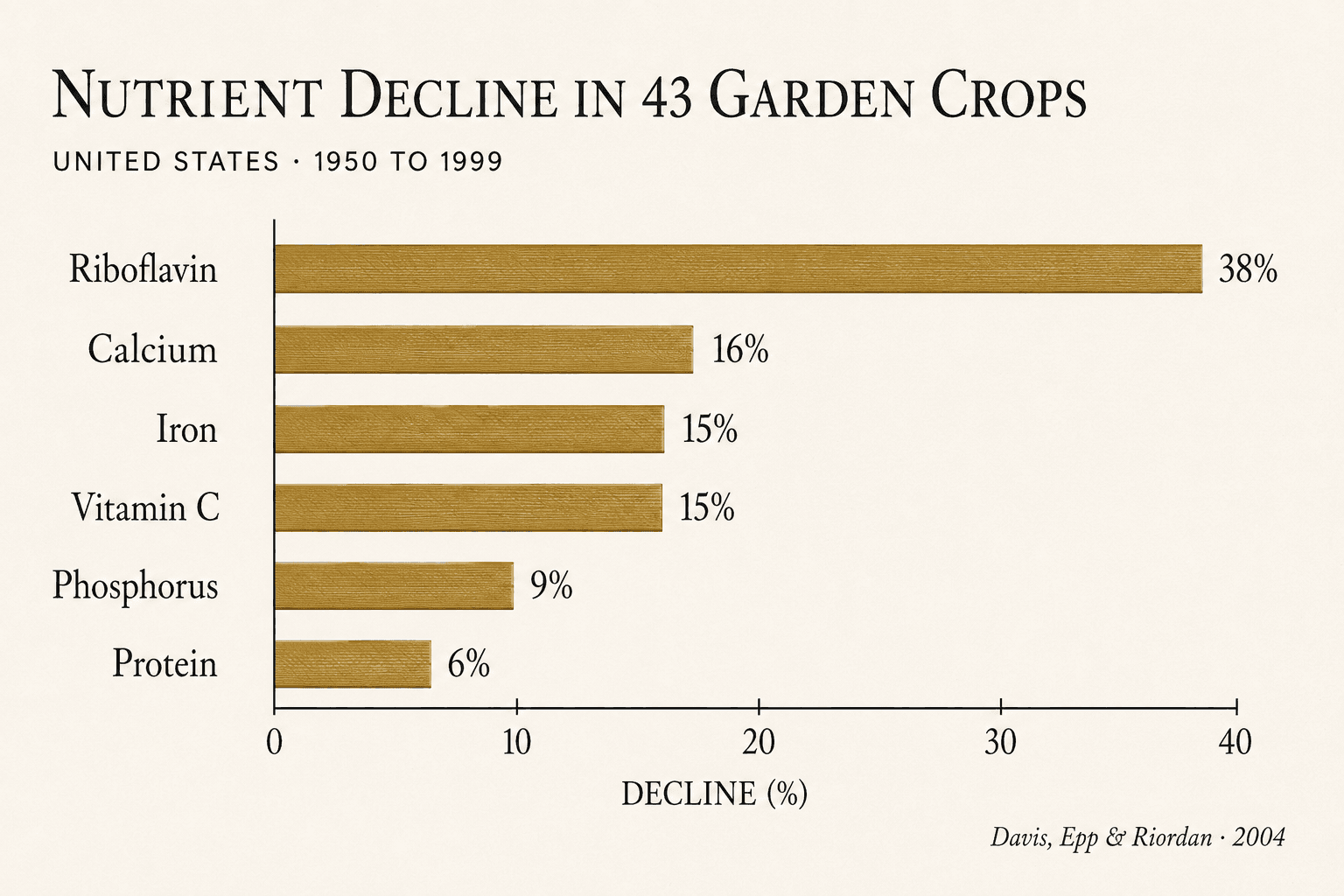
The British Food Journal version (Mayer, 1997), drawing on UK government tables from 1936 against 1991, found steeper declines: magnesium down 19 percent across 27 vegetables, calcium down 27 percent, iron down 49 percent, potassium down 24 percent. The mineral depleted most aggressively, iron, is the one a vegetarian most needs to cover from plants, and the one plants deliver in the form () the body absorbs least efficiently.
A modern spinach leaf delivers a fraction of the iron and magnesium a 1936 leaf delivered. Eating five times the spinach to make up the difference fails, because the same leaf carries five times the oxalate, five times the chelator-load, five times the pesticide burden. The body cannot win that trade.
What animals do that plants do not
Animals are concentrators.
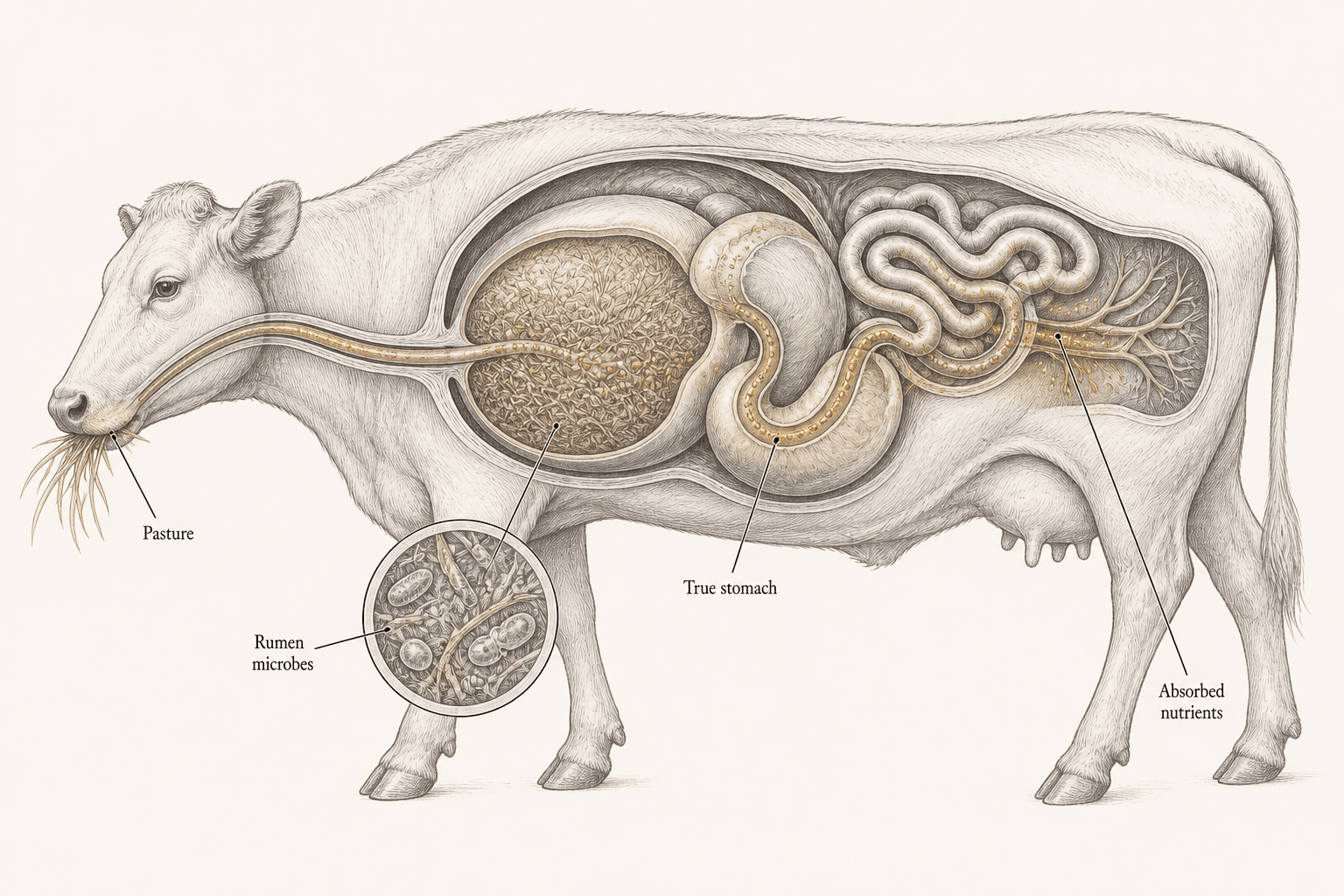
A cow walks an acre of pasture, eats the grass and forbs and herbs a rooted plant could never travel to reach, and pulls minerals out of the soil through a microbial fermentation a human gut cannot replicate. The minerals end up in muscle, fat, liver, kidney, marrow, and connective tissue, in the chemical forms the human body co-evolved to absorb.
Every gram of grass-finished beef liver is the concentrated sum of a few thousand grams of plant matter run through a four-chambered, microbe-staffed reactor we do not have.
Fish concentrate the trace minerals of the ocean, an order of magnitude richer in bioavailable iodine, zinc, selenium, and electrolytes than any terrestrial system. Eggs concentrate the choline, retinol, B12, biotin, and lutein the laying hen pulled out of insects and seeds. Bone marrow concentrates the fat-soluble vitamins and the the body cannot synthesise efficiently from amino acid scratch.
This is not a moral claim. It is a metabolic one.
Five compounds the plant kingdom does not deliver in usable form, each needed daily:
- Vitamin B12. Synthesised exclusively by bacteria, concentrated in animal flesh and offal. Plants contain zero biologically active B12; what nutrition labels report as B12 in spirulina or fermented food is that blocks the real one from absorbing. Vegan B12 deficiency runs at 50 to 90 percent prevalence in long-term cohorts; the consequences (irreversible peripheral neuropathy, methylation collapse, homocysteine-driven cardiovascular damage) take years to surface and years more to reverse.
- Long-chain omega-3 (EPA and DHA). The fatty acids that build neuron membranes, retinal photoreceptors, and the body's primary anti-inflammatory pathway. Found pre-formed only in fish, krill, and certain algae. Plants carry the precursor (ALA, in flax, chia, walnut); the body's conversion rate from ALA to EPA is 5 to 8 percent in men, 10 to 21 percent in fertile women, and from ALA to DHA is 0 to 4 percent across the boardfootnoteBurdge, G. C. and Calder, P. C. (2005). Reproduction Nutrition Development. "Conversion of alpha-linolenic acid to longer-chain polyunsaturated fatty acids in human adults." The conversion is rate-limited by delta-6-desaturase, which competes with the omega-6 conversion pathway and is suppressed by high linoleic acid intake (industrial seed oils).. A vegetarian eating flax is not getting DHA. They are getting raw material the body usually fails to convert.
- Heme iron. Animal-bound iron at 15 to 35 percent absorption against plant non-heme iron at 2 to 20 percent, often closer to 2 to 5 percent in the presence of phytates, oxalates, calcium, polyphenols (tea, coffee), and fibre. This is why vegetarian women tip into iron deficiency at multiples of the omnivore rate.
- Taurine, carnosine, creatine, carnitine. A family of conditionally-essential nitrogenous compounds the body builds from amino acid precursors when those precursors are abundant, and runs short on when they are not. runs the calcium-handling and bile-conjugation systems. defends muscle and brain against glycation damage. buffers the rapid energy demand of muscle and brain. shuttles fat into the mitochondrion for combustion. Plants deliver none of these pre-formed.
- Retinol (active vitamin A) and vitamin K2. Plants carry beta-carotene (precursor to retinol) and K1 (precursor to K2). Body conversion is poor (12 to 1 for beta-carotene under ideal conditions, often 24 to 1 in reality) and almost zero for K1 to K2 unless the gut microbiome is intact. The active forms are concentrated in liver, egg yolk, butter, and aged cheese. K2 specifically routes calcium into bone instead of arteries, the central problem in the minerals essay.
These five gaps are not solved by careful planning. They are solved by eating the animal.
The phytate, oxalate, lectin tax
A second problem sits on top of soil depletion: plants do not want to be eaten. They cannot run, they cannot fight, so they evolved chemistry instead. Three families of plant compounds actively bind minerals in the gut and drag them out unabsorbed.
- Phytates (in grains, legumes, nuts, seeds) bind iron, zinc, calcium, magnesium, and copper in the gut lumen and pass through the digestive tract still holding them. above 25 to 1, typical of unsoaked grain-and-legume diets, drive frank zinc deficiency.
- Oxalates (in spinach, chard, beet greens, almonds, sweet potato, cassava) bind calcium and magnesium and precipitate as insoluble crystals that deposit in kidney (stones), joint cartilage, thyroid, and vascular tissue.
- Lectins (in beans, grains, nightshades) bind gut epithelium and intestinal lining proteins, contributing to in susceptible individuals.
Traditional cultures that ate plants successfully always processed them: soaking, sprouting, fermenting, long cooking, the bread sponge-fermentation that destroys 50 to 70 percent of phytate. Modern plant-based diets generally do not.
The toxin concentration problem
If animals concentrate the good, they also concentrate the bad. This is the strongest argument the vegetarian camp has, and it deserves a direct answer rather than a deflection.
A factory-farmed animal is not the same biological object as a wild or pasture-raised one. The grain-fed feedlot cow, standing in confined animal feeding operation conditions, delivers:
- Whatever was in the corn and soy
- Antibiotics, sub-therapeutic dosing in feed (the single largest driver of resistance in the human supply chain)
- Synthetic hormones (rBST, zeranol, melengestrol acetate, depending on jurisdiction)
- A fat profile inverted toward inflammatory omega-6 (corn-fed cow: 6:1 to 20:1 omega-6 to omega-3) against the 1:1 to 4:1 ratio of grass-finished
- The stress hormones (cortisol, adrenaline) of an animal that lived in pain for its entire shortened life
The farmed-fish version is comparably bad. Hites' 2004 Science paper on farmed salmon, the largest analysis of organic contaminant content in fish done at the time, found PCBs, dioxins, and chlorinated pesticides at concentrations 6 to 10 times higher in farmed Atlantic salmon than in wild Pacific salmonfootnoteHites, R. A.; Foran, J. A.; Carpenter, D. O.; Hamilton, M. C.; Knuth, B. A.; Schwager, S. J. (2004). Science. "Global Assessment of Organic Contaminants in Farmed Salmon." Across 2 metric tons of salmon sampled from major retailers in North America, Europe and South America. The authors recommended consumers limit farmed salmon to one or two servings per month based on EPA contaminant guidelines.. The mechanism: farmed fish are fed fishmeal rendered from whatever the trawler caught, and rendering concentrates the contaminants of the entire ocean food chain into the feed.
The right response is not to skip the animal. It is to source the animal correctly. The rules are short:
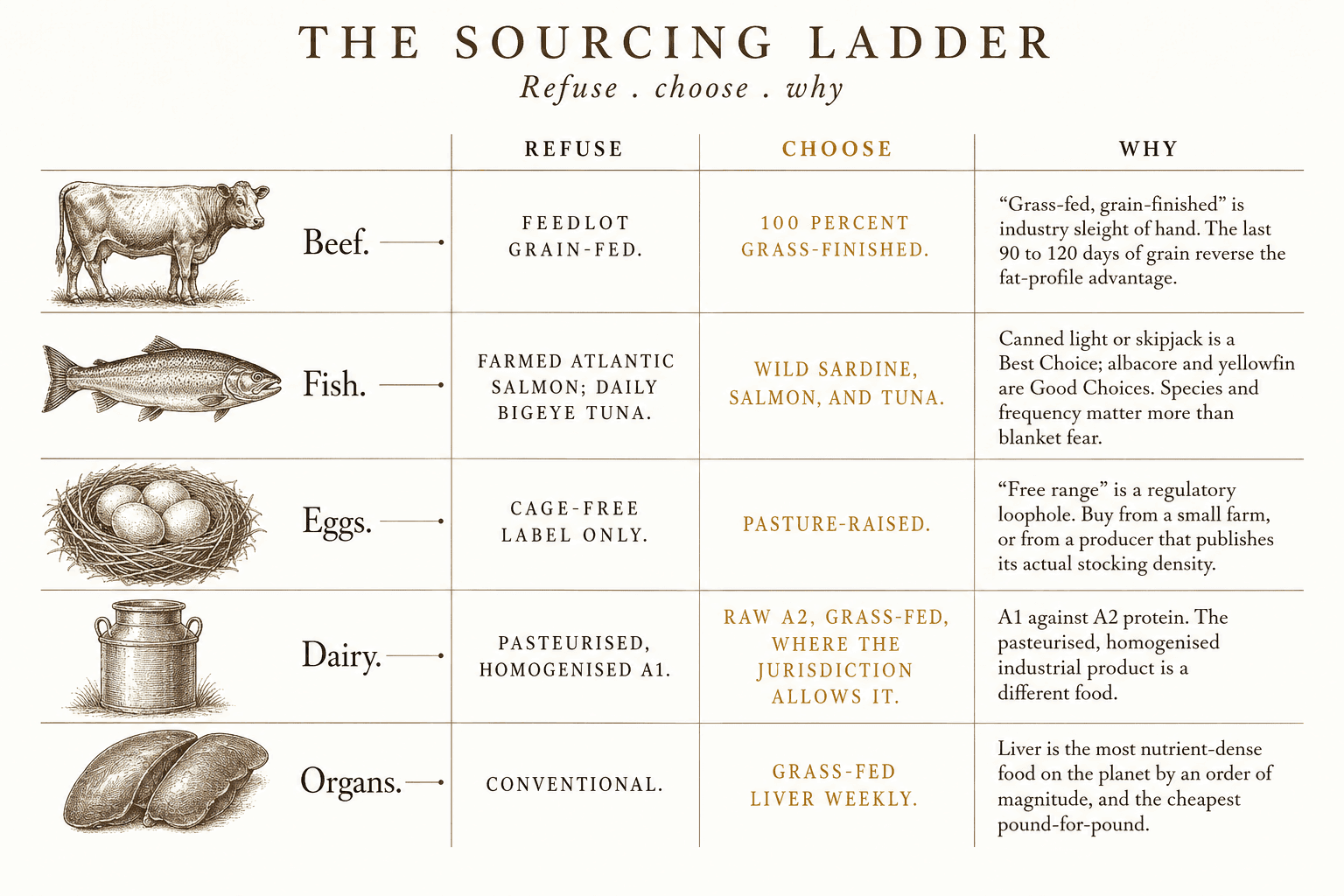
- Beef: 100 percent grass-fed, grass-finished. "Grass-fed, grain-finished" is industry sleight of hand; the last 90 to 120 days of grain reverse the fat-profile advantage. Brands worth the markup: Force of Nature, US Wellness Meats, White Oak Pastures, your local regenerative-grazing rancher.
- Fish: Wild-caught, small-bodied (sardine, anchovy, mackerel, herring, wild Alaskan salmon). Small body means short food-chain position means low bioaccumulation of mercury, PCBs, and microplastics. The big-bodied predators (tuna, swordfish, marlin, large grouper) sit at the top of the chain and concentrate the entire chain's contaminant load.
- Eggs: Pasture-raised (note: not "free range", which is a regulatory loophole) from a small farm if accessible, or from a brand that publishes its actual stocking density. Vital Farms is the supermarket workhorse.
- Dairy: Raw, A2-protein, from grass-fed cows where the jurisdiction allows it. The pasteurised, homogenised, A1-skewed industrial product is a different food.
- Organs: Liver weekly. Marrow when available. The single most nutrient-dense food on the planet by an order of magnitude, and the cheapest pound-for-pound. Most cultures ate it first and gave the muscle meat to the dogs.
Sourcing correctly costs more in money and less in medical bills. The math works.
The acid the meat leaves behind
Everything above is the case for the animal, and the case holds. It also carries one real cost, and a chapter that made the argument without naming the cost would be selling something rather than explaining it.
Protein does not burn clean. The sulfur in methionine and cysteine, the two sulfur-bearing amino acids concentrated in muscle meat, egg, and hard cheese, oxidises to sulfuric acid. The phosphate in phosphoproteins and phospholipids leaves as phosphoric acid. Those are strong mineral acids, not the weak organic acids of fruit, and there is no way to breathe them off the way the lungs exhale the carbon dioxide from burning sugar. They have to be neutralised where they are made, then carried out through the kidney.
An adult eating a Western plate generates something near 50 to 100 milliequivalents of a day this way, roughly one milliequivalent for every kilogram of body weight, and nearly all of it is the protein. Plants run the opposite direction: their potassium salts of organic acids, malate and citrate above all, metabolise to bicarbonate and hand base back to the body. A hundred grams of hard cheese carries an acid load around twenty-five milliequivalents and a hundred grams of meat about nine, while the same weight of spinach, banana, or raisin is negative. The plate does the arithmetic whether or not you do.
The neutralising is done with bicarbonate, and bicarbonate is a reserve, not a river. The kidney regenerates it while excreting the acid as ammonium, and that regeneration is the rate limit on the whole system. Send more acid at it than it can clear and the reserve draws down. What the body does then is what it always does when a buffer runs short: it takes base from where base is stored, and base is stored in the skeleton. Bone is a bank of alkaline mineral, carbonate and phosphate salts of calcium and magnesium, and dissolving a little of it neutralises acid perfectly well. Blood pH never moves, so nothing appears on a panel and nobody is alarmed. The skeleton pays, the freed calcium goes into the urine, and it either leaves as a stone or lands somewhere in the soft tissue, which is the calcification cascade the minerals chapter already traced from the other end.
The kidney's clearing capacity also falls with age, by roughly a percent a year past forty, so the identical plate costs a sixty-year-old body appreciably more than it cost that same body at thirty. Most people eat more meat as they get older, not less, and almost nobody adjusts the buffer.
The cleanest natural experiment is the population this chapter has already used to argue the other side of the case. The Arctic peoples ran the most animal-heavy diet on earth and were superbly adapted to its fat and its protein. When Mazess and Mather measured bone mineral in North Alaskan Eskimo adults in the 1970s, they found it running ten to fifteen percent below the North American reference at every age past forty, with age-related loss starting earlier.footnoteMazess, R. B., Mather, W. (1974). American Journal of Clinical Nutrition. "Bone mineral content of North Alaskan Eskimos." Adults past 40 showed bone mineral content 10 to 15 percent below the reference population, with earlier onset of age-related loss, in a population whose diet was almost entirely animal protein and fat and whose access to alkalising plant food was near zero for most of the year. The genome was tuned for the diet. It was not tuned to conjure alkaline mineral out of nothing, and the plants that would have supplied it do not grow on tundra.
Eat the animal. Then pay for it, in the same day, with the base it takes to burn.
The answer is not less meat. It is the buffer alongside it, and the heavier the animal food the less optional that buffer becomes.
Citrate is the mechanism, which is why the drink is a lemon and not something more elaborate. Citric acid is metabolised through the Krebs cycle and what it leaves behind is bicarbonate, so the fruit that tastes sharply acid in the glass is alkalising by the time it has been through a cell. This is not a fringe reading of it: the alkali salts of citrate are what mainstream nephrology already prescribes to stone-formers, precisely because they raise urinary citrate and urinary pH until the calcium stops precipitating. A teaspoon of bicarbonate does the same job directly and immediately. Taken together in the morning glass, they refill the reserve the day's protein is about to spend, and they cost a few cents.
The people who ate a great deal of meat and stayed sound were never eating it alone. They ate it with unrefined mineral salt, with fermented vegetables, with fruit in its season, and with the bone itself, simmered into a broth that carries its alkaline mineral straight back into the meal it came from. The modern version deletes every one of those and keeps only the steak.
Run the animal plate with the buffer and the case in this chapter holds all the way down. Run it without, and the failure arrives by a different road than the vegetarian's, on a similar clock: not a missing amino acid, but a skeleton quietly spent neutralising a plate that never came with its own base.
Why most plant-based people are sick
Spend a year inside the long-term vegetarian world, in the forums and in the bloodwork people post there, and the same constellation of complaints comes back. The complaints are physical, not psychosomatic, and they are the predictable downstream of years of mineral and amino acid deficit in a body that compensates until it cannot.
The constellation:
- Fatigue that no amount of sleep fixes. B12 deficiency, iron deficiency, low taurine and carnitine, low creatine, magnesium depletion. The body has no fuel substrate and no electron-transport substrate. It runs on willpower.
- Anxiety and depression baseline. Low B12 and folate impair methylation, which impairs serotonin and dopamine synthesis. Low zinc impairs the serotonin-to-melatonin conversion. Low omega-3 DHA thins the brain's lipid membranes, where the receptors live.
- Hair thinning, brittle nails, slow wound healing. Zinc, biotin, sulfur-containing amino acids (cysteine, methionine), collagen substrates. Each is concentrated in animal tissue. None is delivered in usable form by plants.
- Menstrual irregularity, missed periods, infertility. Cholesterol is the substrate for every steroid hormone in the body. A low-fat plant diet without enough saturated, cholesterol-rich animal fat starves the steroid pathway. Add iron deficiency and low B12 on top, and the body powers down reproduction first.
- Tooth and bone deterioration, despite the "calcium-rich" plant claims. Without K2, retinol, and the right magnesium-to-calcium ratio, calcium does not route into bone or tooth structure. shows up as soft enamel, sensitive teeth, accelerated decay.
- Cold hands, cold feet, low body temperature. Hypothyroidism downstream of iodine, selenium, zinc, and tyrosine deficit. The thyroid pulls iodine out of the bloodstream to make T4; without selenium it cannot convert T4 to T3; without iron, zinc, and B12 the basal metabolism cannot run.
- Premature ageing of the face. The connective-tissue substrate (collagen, elastin, hyaluronic acid, glycine, proline, hydroxyproline) is missing. The skin thins, the cheekbones hollow, the eyes sink. There is a specific look that long-term vegans share, the externalisation of a years-long substrate deficit.
The body keeps the receipts. It is patient, then it is not.
The ancestry variable
Tolerance for a plant-heavy diet is not the same in every body, and the difference is written partly into the genome.
Your DNA carries a record of where your ancestors lived and what they could eat there across thousands of years, and that record sets the efficiency of the very machinery at issue here. Two people can sit down to the identical plate of lentils and rice and walk away with two different bodies, because the enzymes that decide what the plate becomes were tuned by two different histories.
The clearest case proves the rule from the favourable side. The peoples of the Indian subcontinent have eaten a plant-forward, frequently vegetarian diet for a hundred generations, and the strict lineages, the Brahmin and the Jain above all, for longer still. A diet held that long becomes a selection pressure on the body running it. The conversion of plant fat into the long-chain fats the brain is built from, the same ALA-to-EPA-and-DHA step already flagged as feeble in most people, is governed by the . A regulatory variant there that sharply raises the conversion rate is carried by the great majority of vegetarian South Asians and is far less common in populations with a long history of eating meat and marine fat.footnoteKothapalli, K. S. D. et al. (2016). Molecular Biology and Evolution. "Positive Selection on a Regulatory Insertion-Deletion Polymorphism in FADS2 Influences Apparent Endogenous Synthesis of Arachidonic Acid." The insertion allele, which upregulates desaturase activity, was carried by roughly 70 percent of a vegetarian South Asian sample and was markedly rarer in a meat-and-marine-eating reference population, a population-level signature of selection for extracting long-chain fats from plant precursors. A South Asian eating a traditional vegetarian diet, soaked and sprouted and fermented and carried in ghee, is working with a genome tuned across millennia for precisely that task. Many do not merely survive it. They flourish on it, and the long-lived vegetarian elders of those lineages are the proof on the hoof.
Now turn the globe to the cold. Where almost nothing green grew for most of the year, the diet was animal by necessity, and the genome adapted to that instead. The Arctic peoples carry their own variants of the same FADS cluster, tuned the opposite way, to down-regulate a conversion they never needed, because they took their EPA and DHA pre-formed from fish and marine mammals.footnoteFumagalli, M. et al. (2015). Science. "Greenlandic Inuit show genetic signatures of diet and climate adaptation." The strongest selection signals in the Inuit genome fell on the FADS fatty-acid cluster, adapting the body's own lipid synthesis to a diet built almost entirely on marine animal fat. The same populations carry a near-fixed Arctic form of the fat-burning enzyme that suits a diet built almost entirely on animal fat. The peoples of the far European north reached the same conclusion by a different road: they adapted to live on animal milk into adulthood, the that is one of the loudest recent signals of selection in the entire human genome, and an adaptation to an animal food, not a plant one. Strip the animal foods from a body whose ancestry coded for them and the machinery to do without them was never installed. That body runs down faster and harder than its owner expects.
The diet a Gujarati grandmother flourishes on can quietly take a Scandinavian apart. The plate is the same. The genome reading it is not.
Ancestry tilts the odds. It never repeals the two hardest constraints.
No human gene, in any population on earth, manufactures vitamin B12. That molecule is made by bacteria and concentrated by animals, and the best-adapted vegetarian genome on the planet cannot synthesise a microgram of it. This is why the thriving Indian tradition that long predates the supplement bottle was never vegan but lacto-vegetarian, leaning on raw milk, ghee, and the incidental microbes of unsterilised food to scrape the B12 together, and why the modern, hyper-clean version of that same diet produces deficiency where the old one did not.
And no genome restores a mineral the soil no longer holds. A favourable FADS profile is worth nothing against a depleted field. The South Asian eating supermarket dal grown on the same exhausted, glyphosate-cycled ground as everyone else's food is eating the same depleted plate as everyone else, advantageous enzymes and all.
So ancestry is the gradient of the hill, not a path around it. It decides how steeply the deficiency contract is priced for you, whether a plant-forward diet is a gentle slope or a cliff face. The soil and the B12 decide that there is a hill at all.
Know your ancestry, eat in the direction it points, and then run, without exception, the discipline that even the most favourable ancestry cannot cover on its own.
The exception: the yogic vegetarian
There is a class of people for whom a vegetarian diet is not only defensible but useful, and they are the half of the picture the omnivore-only camp ignores.
The disciplined yogic practitioner runs a daily practice of pranayama, asana, meditation, and in the more advanced cases the kundalini-rousing techniques of the Indian classical tradition. The traditional yogic teaching, repeated across the Hatha Yoga Pradipika, the Gheranda Samhita, and the lineage texts of the major schools, is correct: meat and fish carry a that depresses the energetic vibration of the practitioner. The metaphysical model and the gut-level observation are the same fact seen from two sides: heavy meat on the day of a deep meditation flattens the meditation.
For a serious practitioner running kundalini techniques daily, the substrate of the body becomes part of the instrument. The traditional dietetic literature describes a refinement column: food becomes plasma, plasma becomes blood, blood becomes muscle, muscle becomes fat, fat becomes bone, bone becomes marrow, marrow becomes , the subtle essence the practitioner then transmutes upward through the spine in the kundalini ascent. The cleaner and lighter the substrate at the input, the more ojas the column produces at the output. This is the same argument made in the sexual transmutation essay about the conserved vital essence being the most concentrated form of the body's energy.
Run this kind of practice seriously and vegetarianism becomes coherent. The energetic gain from a cleaner substrate outweighs the metabolic cost of dropping the animal foods.
But, and here is the part most yogic vegetarians get wrong, the metabolic cost is real and it must be paid in supplementation discipline, or the body breaks down underneath the practice and the practice collapses with it.
The sequence is predictable. The practitioner drops the meat, the practice lifts for six to twelve months, the deficiencies accumulate silently, and somewhere in year two the energy collapses, the immune system fails, the joints ache, the periods stop, the meditation goes flat, and the practitioner blames the practice rather than the substrate.
The conditions under which a yogic vegetarian diet is sustainable, with the soil in the condition it is in:
- Daily B12. Methylcobalamin or hydroxocobalamin sublingual, 1,000 to 5,000 mcg/day. Non-negotiable.
- Daily EPA/DHA from algal oil. 1 to 2 g/day. Third-party-tested algal sources (Nordic Naturals Algae Omega, Testa) are the only vegan option that delivers pre-formed long-chain omega-3 at meaningful dose.
- Daily creatine. 3 to 5 g of creatine monohydrate. The single most-studied supplement in human history; the only one a vegetarian brain measurably benefits from on MRS imaging.
- Daily taurine. 1 to 3 g. Cheap, well-tolerated, restores the calcium-handling and bile pathways the vegetarian under-runs.
- Daily zinc and copper, in the right ratio. 25 mg of zinc as ionic zinc sulfate drops, paired with 1 to 2 mg copper bisglycinate. Phytate-heavy plant diets bind zinc out of the gut; under-supplementing here is the most common silent vegetarian failure.
- Iron, with its cofactors. Heme-free iron supplementation is rough on the gut and only as good as the cofactors (vitamin C, retinol) eaten with it.
- Daily ghee or coconut oil at meaningful dose. Saturated animal-derived or saturated tropical fat as the substrate for the steroid pathway. The fat-fearing vegan version of the diet collapses the hormones inside two years.
- Liver-and-yolk concession, twice a week, for the non-strict. Even two egg yolks a week and a small portion of grass-fed liver covers 80 percent of the B12, retinol, K2, and choline gaps. The strict yogic version refuses; the pragmatic version (the householder yogi, the gruhastha tradition) accepts.
- A multi-mineral that includes the eight essential minerals. The plant matrix cannot deliver these reliably in modern soil conditions. The minerals essay is the floor; the yogic vegetarian is required to maintain it.
This is the discipline a vegetarian practice requires now. Most vegetarians maintain none of it. They eat the lentils, skip the supplementation, and end up depleted.
The depletion looks like spiritual progress at first (lightness, less density) and turns into something else (fatigue, fragility, hormonal collapse) on the back end.
A vegetarian path is possible. An undisciplined vegetarian path is a wasting illness on a delay.
The modern-toxin context
We do not live in 1850. The body is now exposed daily to a load of synthetic chemistry, electromagnetic radiation, microplastic, glyphosate, fluoride, heavy metals from air and water, and ambient industrial residue its detox systems were never designed to handle. Those systems run on substrates: (built from cysteine, glycine, glutamate), (glycine, taurine, methionine), and the methylation cycle (B12, folate, betaine, choline).
Every one of those substrates is concentrated in animal tissue. The argument for animal foods now is stronger than it was in 1936, not weaker, because the body pays a heavier daily detox tax than any generation before it.
Running that tax bill on the substrate of depleted plants alone is the metabolic equivalent of running a steel mill on driftwood. It works for a while; then it does not.
The arc
The strict vegetarian and vegan position would have held in 1850, on intact soil, with an intact microbiome, with the traditional plant preparation the modern table has lost. It does not hold now without active supplementation discipline, and most of the people running it are not running the discipline.
The strict omnivore position, fed by feedlot animals on glyphosate-laden grain, does not hold either. The factory-farmed animal carries the toxin profile of the system that made it.
The defensible position sits in the middle and stays rigorous on both sides.
Eat the animal. Source the animal correctly. Buffer the acid it leaves behind. Eat the plants. Source the plants correctly. Restore the soil substrate where you can grow your own. Supplement the gaps the food chain can no longer cover.
And if a serious yogic or spiritual practice has called the practitioner into a vegetarian discipline, run it with full supplementation honesty, or do not run it.
The body is the instrument, the food is the substrate, and the substrate determines the instrument. There is no spiritual gain in a body that is failing.
But even food sourced perfectly cannot close the last gaps a depleted century leaves open. That job belongs to the bottle, and the bottle is its own minefield of fillers, wrong forms, and useless doses. Which few supplements actually earn their place, and how to read a label that is designed to mislead you, is the work of the supplement buyer's manual that comes next.
Sources
- Changes in USDA Food Composition Data for 43 Garden Crops, 1950 to 1999, . https://pubmed.ncbi.nlm.nih.gov/15637215/
- Historical Changes in the Mineral Content of Fruits and Vegetables, . https://doi.org/10.1108/00070709710181540
- Nutritional and Greenhouse Gas Impacts of Removing Animals from US Agriculture, . https://www.pnas.org/doi/10.1073/pnas.1707322114
- Global Assessment of Organic Contaminants in Farmed Salmon, . https://www.science.org/doi/10.1126/science.1091447
- Detection of Glyphosate Residues in Companion Animal Feeds, . https://pubmed.ncbi.nlm.nih.gov/30253302/
- How Prevalent Is Vitamin B12 Deficiency among Vegetarians?, . https://pubmed.ncbi.nlm.nih.gov/23356638/
- Conversion of Alpha-Linolenic Acid to Longer-Chain Polyunsaturated Fatty Acids in Human Adults, . https://pubmed.ncbi.nlm.nih.gov/16188209/
- Positive Selection on a Regulatory Insertion-Deletion Polymorphism in FADS2 Influences Apparent Endogenous Synthesis of Arachidonic Acid, . https://pmc.ncbi.nlm.nih.gov/articles/PMC4915354/
- Greenlandic Inuit Show Genetic Signatures of Diet and Climate Adaptation, . https://www.science.org/doi/10.1126/science.aab2319
- Benefits of Creatine Supplementation for Vegetarians Compared to Omnivorous Athletes: A Systematic Review, . https://doi.org/10.3390/ijerph17093041
- Phytate in Foods and Significance for Humans, . https://doi.org/10.1002/mnfr.200900099
- Bone Mineral Content of North Alaskan Eskimos, . https://pubmed.ncbi.nlm.nih.gov/4412233/
- Diet, Evolution and Aging, . https://pubmed.ncbi.nlm.nih.gov/11842945/
- Nutrition and Physical Degeneration, . https://openlibrary.org/works/OL98980W
- Nourishing Traditions, . https://openlibrary.org/works/OL2846748W
- Caraka Samhita, . https://openlibrary.org/works/OL32348043W
- Cancer, Sulfur, Garlic and Glutathione, . https://drsircus.com/cancer/cancer-sulfur-garlic-glutathione/
Next in the series
The Incorruptible Body · The GroundThe Supplement Buyer's Manual, Why Less Is More and How to Choose What WorksMost supplement tablets are 80 percent filler and a poorly absorbed remainder. The fillers to refuse on sight, why ionic and liquid beat tablet, and the minimum effective daily stack.
- Published
- Reading
- 19 min
- Sources
- 17