
The Last Library
A single machine now answers most of the questions humanity asks, and it does not answer to you. The most useful knowledge about your own body has been buried on purpose. Here is how to dig it back out, and how to verify every word of this book for yourself.
A question forms in your mind, still half-shaped, and before you have turned it over even once, your hand has already typed it into the machine. You did not think the thought. You handed it away, and a single fluent answer came back, smooth and certain, in a voice built to sound like it knows.
This is the quietest theft of the age, and it cannot work without your help. What is being taken is the one faculty that makes you a sovereign person rather than a managed one: the ability to work a thing out for yourself.
The mind is a muscle and inquiry is its exercise. The struggle to find a source, to hold two contradictory accounts in your head at once, to sit in the discomfort of not knowing and push through it, that struggle is not the obstacle on the way to understanding. It is the understanding.
We already know what happens when the struggle is removed. The moment a fact became a click away, we began remembering where to find it instead of remembering the fact itself, .footnoteSparrow, B., Liu, J., and Wegner, D. M. (2011). Google Effects on Memory: Cognitive Consequences of Having Information at Our Fingertips. Science, 333(6043), 776-778.
Now run that same trade one level higher, from memory to judgment. Let the machine remember for you and you forget. Let it reason for you and you lose, slowly and without noticing it go, the capacity to reason at all.
A people who cannot weigh a claim for themselves cannot govern themselves. They can only be told.
For thirty years, to learn something was to run a search. You typed a few words and got a hundred doors: a government page, a forum fight, a stranger's blog, a sales pitch wearing a study's clothes. The work of judgment was left to you, and somewhere in that friction you built a view that was your own. The mess was the freedom.
That age is ending. We are moving from search to answer. You no longer get a hundred doors, you get one reply, synthesized and smooth, and the labor of comparing sources is lifted from you, and with it the authority to decide what is true.
A single answer is not a window onto the world's many views. It is an editorial, and it carries a position whether or not you are ever shown one.
You are no longer reading the library. You are reading the librarian, and you cannot see which shelves were skipped.
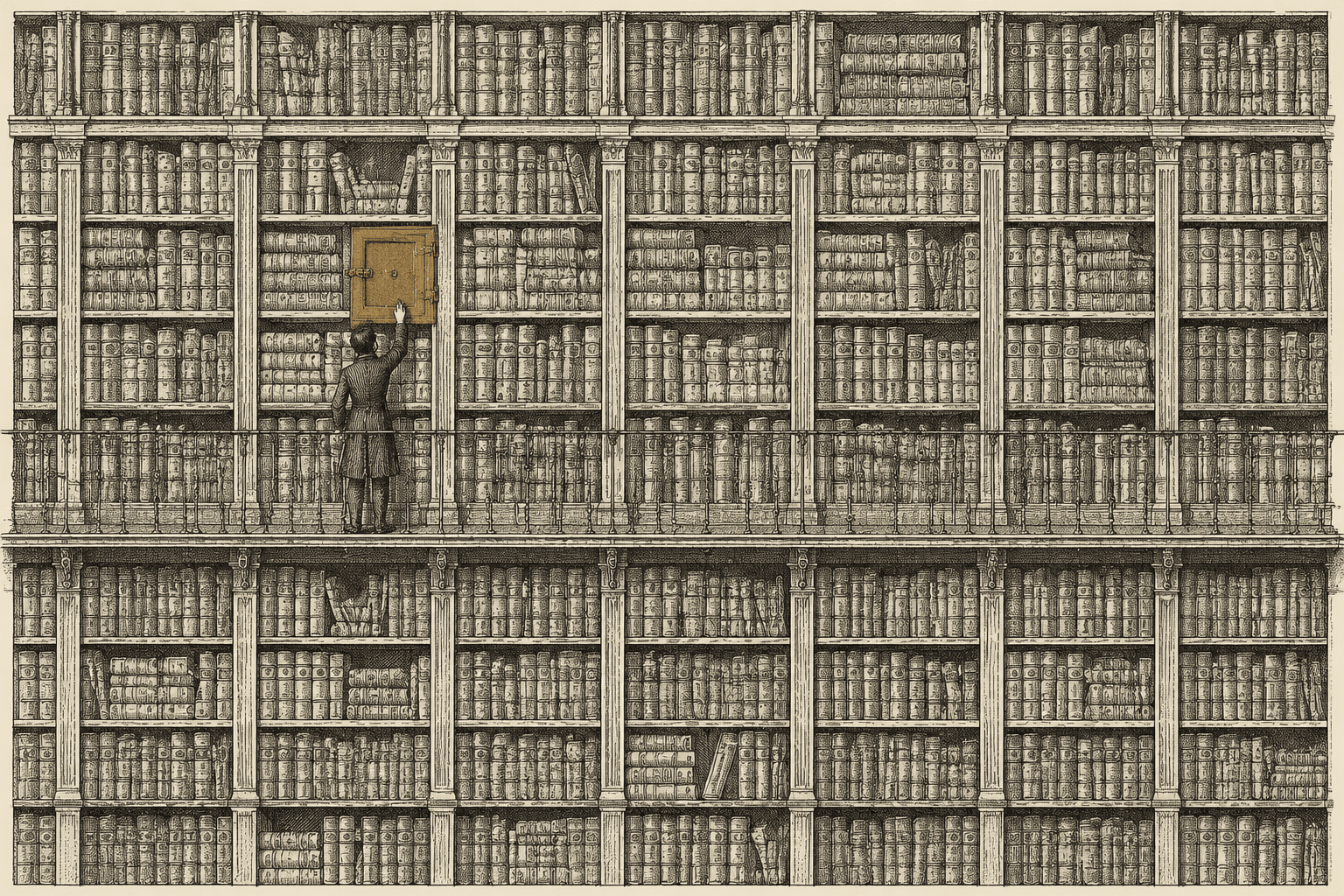
Now look at who holds the librarian, and look without flinching. One company answers most of the questions humanity asks, and it does not answer to you. It answers to the interests that pay it.
Pharmaceutical companies outspend every other industry on lobbying, and they spend it to protect a single story about your health: that disease is something you manage with a patented drug, for the rest of your life. A search engine that ranks results by "authority" and "consensus" is the perfect machine for enforcing that story.
The findings that cut against it, the cheap, the unpatentable, the inconvenient, are not banned outright. They are buried, ranked down to a page no one reaches, while the approved answer sits at the top wearing the costume of neutrality.
The AI is tuned harder still. Ask one about the mechanisms in this book, the compounds, the protocols, the parts of the body it has been trained to call dangerous, and it will refuse, hedge, or march you back to the mainstream line before you have finished the question.
Not because the answer is unknown. Because it was built to withhold it. Certain knowledge is treated as too powerful to leave in the hands of the general population, so the machine is trained to keep it from you and to call that restraint safety.
What it hides is usually the exact mechanism that would free you from the product it is protecting.
Omission is the only censorship that leaves no fingerprints. The citation exists. You are simply never shown it.
That is the position of this book, stated without apology. The most valuable knowledge about your own body has been made the hardest knowledge to find, on purpose. These pages gather it back into one place. Which is also why you should take none of it on trust, and exactly why you are able to check every line.
Begin here. Do not believe one claim because it is written well. Every claim in these pages is bolted to a named mechanism and a citable source for one reason: so that you can take it apart. Take any claim that sounds too large and verify it yourself: search the compound, the author, the exact title of the study.
Not on Google, which has already decided what you should find. Use DuckDuckGo. It does not track you, it does not bend the page to keep you comfortable, and it does not share Google's stake in protecting the consensus, so the studies, the case reports, and the original texts actually surface.
Read the primary source with your own eyes. Steelman the account that disagrees before you dismiss it. Ask who funded the finding and who profits from your believing it.
The current does not run in our favour, and it will not. These systems will only grow more fluent, more central, harder to think around. That is exactly why the habit has to be built now.
Reach for your own mind first. Then reach for the machine. The order is everything.
Sources
- Google Effects on Memory: Cognitive Consequences of Having Information at Our Fingertips, . https://doi.org/10.1126/science.1207745
- The Shallows, . https://openlibrary.org/works/OL15297392W
- The Filter Bubble, . https://openlibrary.org/works/OL15747216W
- The Age of Surveillance Capitalism, . https://openlibrary.org/works/OL18201749W
Next in the series
The Incorruptible Body · The GroundEssential Minerals for Health and Well-BeingEight minerals run roughly eighty percent of the systems that send people to specialists, and the standard blood panel tests for almost none of them. The named mechanisms, the exact doses, and the protocol that restores the set.
- Published
- Reading
- 4 min
- Sources
- 4