
The Water Nature Never Made
No water any of your ancestors ever drank reached the pH a machine now sells you, your stomach deletes that pH on contact, and the body's own buffer, bicarbonate, does the job for a few cents. Support the regulator, do not believe a countertop gadget is smarter than your kidneys.
No human being who ever lived, before the machine, drank water as alkaline as the glass on the counter promising to alkalise you. Rain falls mildly acidic. Rivers and springs run close to neutral. The pH ten in that glass is not a deeper kind of nature, it is an electrical product, made on a charged plate, that the species spent its entire evolution never once tasting. And the moment you swallow it, the most aggressive acid bath in your body destroys the one property you paid for.
The pitch is old and intuitive. Modern life leaves you acidic, acid is where disease grows, drink the opposite and be well. So a machine plumbs into the tap, runs the water across charged plates, and pours out a glass that turns the test strip a confident blue, pH nine, pH ten.
Millions now organise their grocery list and their water bill around it. They are pouring an outlier into a system that already runs the most refined acid-clearing process on the planet.
The body already runs the master system
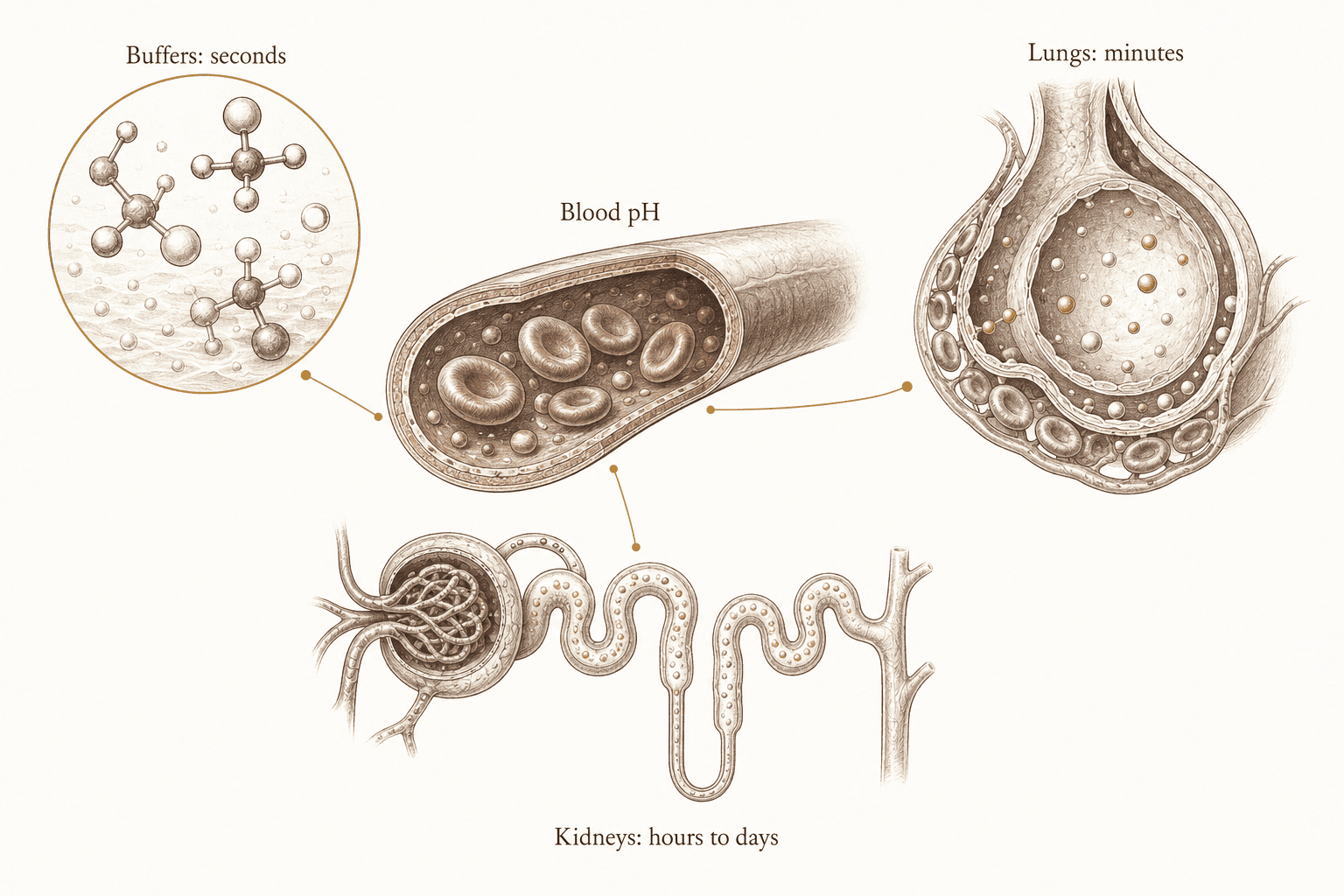
Your blood pH is one of the most fiercely defended numbers in your physiology. It sits between 7.35 and 7.45, very slightly alkaline, held there by three overlapping systems on three different clocks, because if it drifts even a few tenths in either direction the enzymes that run your metabolism begin to misfold and fail.
The first line is chemical and instant. The blood carries the , a chemical shock absorber that swallows incoming acid or base in seconds, before the pH can move at all.
The second line is your breath. Carbon dioxide dissolved in blood is carbonic acid, so the moment acidity creeps up, the brain tells the lungs to breathe a little harder and blow the surplus off as gas.
The third line is the kidneys, the slow and total regulator, excreting excess hydrogen into the urine and reclaiming bicarbonate over hours and days, trimming the balance to the last decimal.footnoteGuyton, A. C., Hall, J. E. Textbook of Medical Physiology. Arterial blood pH is regulated within roughly 7.35 to 7.45 by three mechanisms on three timescales: the bicarbonate buffer system (seconds), respiratory compensation through CO2 exhalation (minutes), and renal compensation through hydrogen-ion excretion and bicarbonate reabsorption (hours to days).
This is , and it is not delicate. It is one of the most capable control loops in the body, precisely because so much depends on it. The proof is in when blood pH genuinely does move: never at lunch, only in catastrophe.
Acidosis and alkalosis come from kidney failure, from lungs that cannot clear carbon dioxide, from uncontrolled diabetes burning ketones, from sepsis. They are emergencies treated in hospitals. A body whose pH could be swung by a glass of water would not survive a week.
There is one true thing buried inside the marketing, and it matters. The body carries a real daily acid load. Protein, metabolism, exercise, and the modern diet leave a net acid the kidneys have to clear, and to clear it the body spends bicarbonate, and when the buffer runs short it will borrow mineral base from bone to keep the blood constant.
So topping up that buffer is worth doing. The question was never whether you can support the system. It is which tool does it, and whether you support the regulator or try to overrule it.
The water nature never made
Set the body aside and ask the simpler question: where in nature does water like this occur. Almost nowhere a person could drink.
Rain reaches the ground mildly acidic, settling near pH 5.6 as it equilibrates with the carbon dioxide in the air. Rivers, lakes, and springs run roughly between 6.5 and 8.5, clustering close to neutral, set by the rock and soil they pass through. Glacial melt, low in dissolved mineral, sits near neutral or slightly below. Seawater holds around 8.1, and no ancestor drank the sea.footnoteStumm, W., Morgan, J. J. Aquatic Chemistry. The pH of natural surface and ground waters is governed mainly by the carbonate equilibrium and typically falls between about 6.5 and 8.5; rainwater equilibrated with atmospheric CO2 settles near 5.6. Waters reaching pH 9.5 to 11, such as closed-basin soda lakes (Mono Lake, Lake Natron), are highly mineralised caustic brines, not potable water.
The water the human body was tuned on, across the millions of years that built every enzyme and every stretch of gut you carry, sat in a narrow band from mildly acidic to mildly alkaline, and it was light in dissolved mineral. The pH 9.5 to 10 an ioniser delivers is a number almost nothing in nature ever offered up to drink.
The rare natural waters that do reach it, the soda lakes and a handful of volcanic springs, are caustic enough to strip feathers, undrinkable by anything with a kidney. Alkaline water is not the ancestral default the marketing implies. It is a twentieth-century invention wearing the costume of nature.
No water our species ever drank was this alkaline. The machine did not find a deeper nature. It manufactured a number, then sold it back to you as the thing you had lost.
And the stomach was built to undo it
Before the kidney is ever involved, there is a gate, and it was designed to do exactly the opposite of what the marketing promises. Your stomach is an acid bath, held deliberately between pH 1.5 and 3.5, strong enough to break down protein and kill most of what you swallow.
Pour a glass of pH 9 water into that and the acid neutralises it on contact, instantly. If enough volume arrives to nudge the stomach upward at all, the stomach senses the change and secretes more acid to drive it back down, because a stomach that stays alkaline cannot digest.footnoteGuyton, A. C., Hall, J. E. Textbook of Medical Physiology. Gastric fluid is maintained at roughly pH 1.5 to 3.5 by parietal-cell acid secretion, which is regulated to restore the acidic set point when buffered. Ingested alkaline fluid is neutralised in the stomach before reaching the small intestine, where absorption occurs.
So the alkaline water's one headline property, its high pH, is gone within seconds of arrival, taken apart by the same body the label claims it is correcting. The number on the strip describes the water in the glass. It says nothing about the body after the swallow.
When researchers went looking, rigorously, for clinical evidence that alkaline water prevents cancer or any other disease, they found none. A systematic review in 2016 examined the whole chain of claims and concluded that the public promotion of alkaline water was not justified by the evidence.footnoteFenton, T. R., Huang, T. (2016). Systematic review of the association between dietary acid load, alkaline water and cancer. BMJ Open, 6(6), e010438. The review found no clinical-trial evidence that alkaline water alters systemic acid-base status to prevent or treat disease, and concluded the public promotion of these products was not supported by the data. The physiology had predicted that emptiness decades before anyone went looking.
What "alkaline" actually buys you is minerals
The word doing all the work on the bottle does not mean what people think. In wellness it is read as a synonym for healthy, the wholesome opposite of acidic. In the actual chemistry of water it means something far more specific and far less romantic.
is buffering capacity. It is the measure of how much acid a water can absorb before its pH drops, and it comes almost entirely from dissolved carbonates and bicarbonates, which travel hand in hand with calcium and magnesium.
So alkaline water is, at bottom, a fancy name for water with minerals dissolved in it. The high pH the ioniser produces is not the machine conjuring health into the water. It is the machine concentrating, at its negative plate, the minerals the source water already carried. Strip those minerals out and the alkalinity goes with them, because they were the alkalinity.
And that mineral load is the inorganic hardness that furs up a kettle. Your gut takes up that calcium and magnesium far less readily than the same elements bound into a leaf of spinach, and they arrive escorted by whatever else the supply was carrying, the lead, the fluoride, the rest of it.
The cleanest proof is distilled water. Reduced to almost nothing but itself, its dissolved solids near zero, it has almost no , which means, by the definition above, essentially no alkalinity.
You cannot give it an alkaline reading without dissolving minerals back in. Put the pipe's hardness back in and you have simply undone the distillation. Put in the bicarbonate and magnesium you chose yourself and you have the water Distilled and Structured builds: purified to nothing, then mineralised by decision instead of by accident. The alkaline reading is a side effect of that choice, never the reason for it.
If the cleanest water you can make scores worst on your meter, the meter was never measuring health. It was measuring dissolved rock.
Why bicarbonate is the better base
The alkaline-water customer wants the right thing and reaches for the wrong tool. There is a tool made for the job, and it is not a machine.
Bicarbonate is the body's own buffer. It is the exact molecule the kidneys reabsorb and the pancreas secretes to hold pH every second of your life.
When you take , along with the citrate from a lemon, which the liver converts straight to bicarbonate, you are not forcing a foreign high pH past the stomach and hoping. You are handing the body more of the single currency it already runs on. And unlike the alkaline water, this one survives the journey: dosed bicarbonate genuinely raises , the blood's buffer reserve, without ever trying to move the defended pH at all.footnotede Brito-Ashurst, I., Varagunam, M., Raftery, M. J., Yaqoob, M. M. (2009). Bicarbonate supplementation slows progression of CKD and improves nutritional status. J Am Soc Nephrol, 20(9), 2075-2084. Oral sodium bicarbonate produced a measurable, sustained rise in serum bicarbonate, the clinical demonstration that ingested bicarbonate reaches the blood as a larger buffer reserve, which alkaline water, neutralised at the stomach, does not.
The difference from the ioniser is control. You choose the buffer, the dose, the form, on a clean slate of your own making, instead of drinking whatever mineral cocktail the pipe and the plates happened to hand you and calling the number on the strip your health.
This is the whole basis of the lemon and bicarbonate protocol, and the magnesium bicarbonate water in Essential Minerals delivers the same buffer by design. One is a few cents of the exact thing the body makes. The other is a several-hundred-dollar appliance selling you a pH your stomach deletes on contact.
We are not smarter than the kidney
The alkaline movement is a single act of hubris. It looks at an organ system that has held your blood pH to two decimal places, through every meal, every fever, every day of your life, and decides a countertop machine knows the job better. It does not. Nothing we have built regulates a buffered system as well as the body you were born owning, and nothing nature ever offered to drink was as alkaline as the thing we now sell back to ourselves as natural.
The honest posture is the older one. Trust the system. Support it with the buffer it already makes, taken deliberately and in a dose you control. Eat the minerals in their living form. Breathe slow enough to keep your own carbon dioxide. Get the sun.
Then leave the regulator alone to do the work it was built for. The body was tuned, across a few billion years of selection, or by something you may prefer to call a Creator, to handle this long before anyone thought to sell it a brighter machine.
So drop the pH axis. It was never the variable you could move, and chasing it is chasing a number the body owns and will not surrender.
The water worth drinking is not alkaline. It is clean, distilled to nothing, re-mineralised on purpose, structured, alive, the way Distilled and Structured sets out. With the instrument cleared and the buffer it recognises handed back, the body is finally ready for the one current the alkaline machine could never bottle and no plate could ever charge: the deepest energy you already carry, and what it becomes when you stop spending it and learn to raise it instead.
Sources
- Textbook of Medical Physiology, . https://openlibrary.org/works/OL17627866W
- Systematic Review of the Association between Dietary Acid Load, Alkaline Water and Cancer, . https://doi.org/10.1136/bmjopen-2015-010438
- Aquatic Chemistry, . https://openlibrary.org/works/OL3528131W
- Bicarbonate Supplementation Slows Progression of CKD and Improves Nutritional Status, . https://pubmed.ncbi.nlm.nih.gov/19608703/
- Distilled and Structured, . https://samsinger.tech/writing/2026-06-21-distilled-and-structured-water
- Alkaline Without Alkalinity, . https://drsircus.com/sodium-bicarbonate-baking-soda/alkalinity-ph-2/
Next in the series
The Incorruptible Body · The FireSexual TransmutationThe most concentrated creative material the body makes, the spinal channel it can rise through, and the discipline that turns appetite into output.
- Published
- Reading
- 8 min
- Sources
- 6